


Luggage Warranties: 10 Years, Lifetime… But What Is Actually Covered?
Luggage Warranties: 10 Years, Lifetime… But What Is Actually Covered?
When purchasing a suitcase, a 5-year, 10-year or even lifetime warranty may seem like an excellent indication of quality. However, the length of the warranty tells only part of the story. What really matters is what the warranty covers — and, more importantly, what it excludes.
Some 10-year warranties include a particularly important exclusion: moving or removable parts. Yet these are precisely some of the components most likely to break during the useful life of a suitcase.
A 10-Year Warranty That Doesn’t Cover the Wheels?
Before being impressed by the length of a warranty, take a few minutes to read its exclusions.
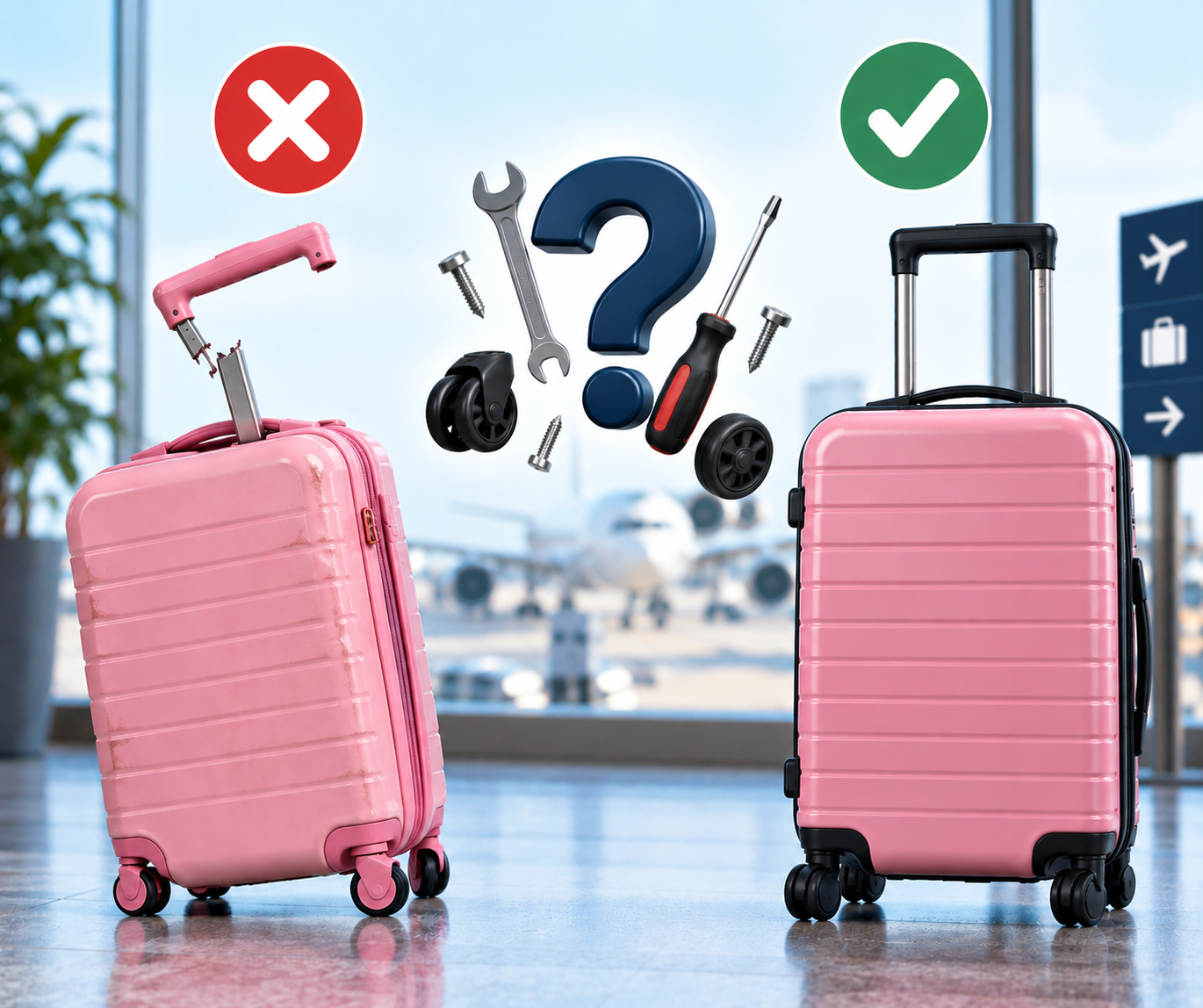
Some brands specifically exclude wheels and other moving parts from their warranty. This can make a considerable difference for consumers, since wheels, telescopic handles, carry handles and certain mechanisms are among the most heavily used components of a suitcase.
It is also important to consider the long-term availability of replacement parts. Highly distinctive components or parts specific to a particular collection can become especially difficult to replace a few years later. For example, a wheel with a blue hubcap or another distinctive colour, or a coloured top on a telescopic handle, may be much harder to find once the collection is discontinued. Even if a compatible replacement part still exists, it may no longer be available in the original colour.
If you intend to keep your suitcase for many years, choosing wheels, handles and components in standard colours is generally a smarter choice and can make future repairs much easier.
The shell or fabric may remain in excellent condition for years, while a single wheel or component of the telescopic handle eventually fails.
The question then becomes very simple: What is the value of a 10-year warranty if some of the parts most likely to require repair are not covered — and may eventually become impossible to replace?
This also reinforces an important environmental point: repairability begins with the design of the product, not only when something breaks.
Parts Availability Is Just as Important as the Warranty
It is also important to consider what will happen after the warranty expires — or when a part is excluded from the warranty.
A good luggage repair centre can replace a wheel, handle and many other suitcase components… provided the required part is available.
With some lesser-known brands, replacement parts can be difficult or even impossible to obtain. And when a manufacturer does not cover certain moving parts under its warranty, it becomes particularly important to determine whether those parts are at least available for paid repairs.
A suitcase that is otherwise still perfectly usable can become impossible to repair simply because a replacement wheel is unavailable.
Where Is the Authorized Repair Centre?
This is a question very few consumers think to ask before making a purchase:
“If my suitcase breaks, where will I have to get it repaired?”
A brand may offer a lengthy warranty while having very few authorized repair centres in Canada.
Before buying, check:
- whether the brand has an authorized repair centre in your area or province;
- who pays the shipping costs to the repair centre;
- whether return shipping is also at your expense;
- whether replacement parts are available in Canada;
- and whether you need authorization or a claim number before bringing the suitcase to a repair centre.
Shipping a large suitcase across Canada can be expensive. A “warranty repair” becomes considerably less attractive when the consumer has to pay substantial transportation costs to obtain it.
Be Careful When Buying Luggage From Foreign Websites
The same issue can arise with luggage purchased from websites located outside Canada.
A warranty advertised on an American, European or Asian website does not necessarily mean that warranty service will be available in Canada. Distribution and repair networks may differ from one country to another, and some warranties are restricted to the market in which the product was purchased.
A slightly lower purchase price can quickly become much less attractive when the first problem occurs.
Before purchasing luggage from a foreign website, make sure the warranty is valid in Canada, that a Canadian repair network exists and that replacement parts are available here.
An Environmental Issue That Is Too Often Overlooked
There is also an important contradiction when a suitcase is marketed as a sustainable or environmentally friendly choice while being virtually impossible to repair.
A suitcase should not become waste simply because a small wheel has broken.
Repairing a suitcase and extending its useful life generally makes far more sense than replacing the entire product because of one defective component.
A truly environmentally responsible approach should therefore consider not only the materials used to manufacture the suitcase, but also the product’s repairability, the availability of replacement parts and the existence of a long-term repair network.
Otherwise, the first time a wheel or handle breaks, a suitcase that is still in excellent condition may simply end up in the garbage.
Before Buying Your Next Suitcase
Don’t choose a suitcase simply because the label says “10-year warranty” or “lifetime warranty.”
At JP Grimard, after decades of selling and repairing luggage, we know that a good warranty is one that consumers can actually use.
Find out what is covered, what is excluded, whether replacement parts are available, where authorized repair centres are located and whether you may have to pay transportation costs.
A shorter but more comprehensive warranty, backed by readily available parts and a genuine repair service, can sometimes be far more valuable than a 10-year warranty filled with exclusions.
A repairable suitcase is a suitcase that can travel longer. And the most environmentally friendly suitcase is often the one you don’t have to replace.